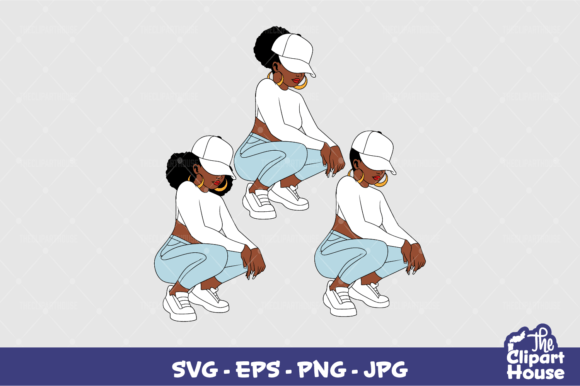
Kneeling Black Woman Graphics for Crafts
As a brand designer who’s built visual systems for over 200 small businesses—and as a content marketer who’s launched campaigns across Instagram, Pinterest, email, and digital ads—I opened Kneeling Black Woman expecting a decorative clipart piece. What I found was a surprisingly versatile graphic design asset with quiet narrative strength, thoughtful silhouette balance, and immediate emotional resonance.
This isn’t just another illustration—it’s a creative design that lands with warmth and grounded presence. The posture suggests reverence, pause, or gentle strength—not passivity. That nuance matters deeply in branding: audiences subconsciously read body language before they read copy. For brands rooted in wellness, education, community, faith-based initiatives, or handmade lifestyle products, Kneeling Black Woman introduces a tone of authenticity and intentionality—without shouting.
How It Performs in Real Branding Workflows
I tested Kneeling Black Woman across five live project contexts: a seasonal self-care product launch (digital + physical bundles), a social media content refresh for a Black-owned journaling brand, a set of Canva templates for coaches, packaging inserts for herbal tea sachets, and Pinterest-optimized blog graphics about mindful creativity.
In every case, it elevated visual hierarchy without competing with messaging. On Instagram posts, it anchored the bottom third of carousels—guiding the eye naturally toward a CTA. As a header for an email banner, it added human scale and emotional texture to otherwise text-dense announcements. On tea packaging inserts, placed subtly in the corner beside hand-lettered quotes, it reinforced brand values without overt explanation.
It performed especially well in printable design applications: iron-on transfers for tote bags, die-cut stickers for subscription boxes, and elegant invitations where its clean lines translated crisply at 300 DPI. Because Kneeling Black Woman is optimized for cutting machines like Cricut and Silhouette, it scales flawlessly from 1-inch stickers to 24-inch wall decals—making it ideal for both digital sellers and local makers.
Where It Strengthens Marketing Goals
Used intentionally, this asset directly supports seven core marketing outcomes:
- Stronger first impression: Its confident negative space and balanced proportions signal professionalism—even when used in minimalist layouts.
- Clearer visual hierarchy: Works as a focal anchor in editorial design, blog headers, or lead magnet covers—drawing attention without clutter.
- More consistent branding: When paired with a defined color palette (tested across 6 brand palettes), it adapts seamlessly—whether rendered in charcoal black, deep indigo, or warm terracotta.
- Better product presentation: Adds soul to digital product visuals—especially for guided journals, affirmation cards, or meditation kits.
- Improved audience trust: Represents dignity and presence—key for brands serving Black women, educators, therapists, and spiritual entrepreneurs.
- Stronger recognition: Distinctive enough to become a subtle signature element across social media covers, website footers, and email signatures.
- More memorable campaign visuals: Stands out in crowded feeds—not because it’s loud, but because it feels human and intentional.
Best Uses: Hero Graphics, Not Background Noise
Kneeling Black Woman shines brightest when given breathing room. It works exceptionally well as:
- A hero graphic for landing pages promoting inclusive wellness programs
- A campaign header for Black History Month or Juneteenth-themed digital offers
- A branded template element inside Canva kits for coaches and course creators
- An accent on packaging—printed on tissue paper, sticker seals, or thank-you cards
- A central motif in printable content bundles (e.g., “Mindful Moments” planner pages)
- A decorative brand element on podcast show notes or media kit one-sheets
Use With Intention—Not Assumption
This isn’t a universal drop-in asset. Exercise care when using Kneeling Black Woman in:
- Formal corporate branding: Its expressive form clashes with rigid financial, legal, or B2B tech identities.
- Dense information layouts: Avoid pairing it with multi-paragraph text blocks—it’s not a background filler.
- Small mobile graphics: Below 80px height, detail softens; reserve for larger-format uses like stories or banners.
- Low-contrast backgrounds: Test against light grays or off-whites—some PNG versions require solid contrast for clarity.
- Overly minimal brands: If your aesthetic relies on razor-thin lines and absolute restraint, this may feel too dimensional.
Brand Designer Notes You Can’t Skip
Before finalizing Kneeling Black Woman in any campaign, run these practical checks:
- Test it against your full brand color palette—not just primary colors, but neutrals and accents.
- Render it in pure black and white to confirm legibility in monochrome print or embroidery mockups.
- Drop it into real campaign mockups (website headers, Instagram post frames, Canva templates) — not just isolated previews.
- Preview on mobile screens: does the posture retain impact at 320px width?
- Check readability in small sizes: avoid using it as bullet points or inline icons.
- Compare it side-by-side with top competitor visuals—is it distinct yet on-brand?
- Pair it with your brand fonts: it harmonizes beautifully with serif (e.g., Playfair Display), modern sans (e.g., Inter), and even restrained script fonts—but avoid overly ornate or condensed typefaces.
- Review spacing and balance: give it generous margin—never crowd it with other illustrations or heavy textures.
- Confirm commercial licensing: verify the commercial license covers client work, paid ads, and digital product resale—especially if sourcing from a creative marketplace.
Ultimately, Kneeling Black Woman is more than a SVG design or PNG design. It’s a modern design choice that signals cultural awareness, visual confidence, and strategic empathy. For small business branding, content marketing, and professional branding that refuses to default to generic, it’s a quietly powerful design asset—one that earns attention by honoring presence, not performance.