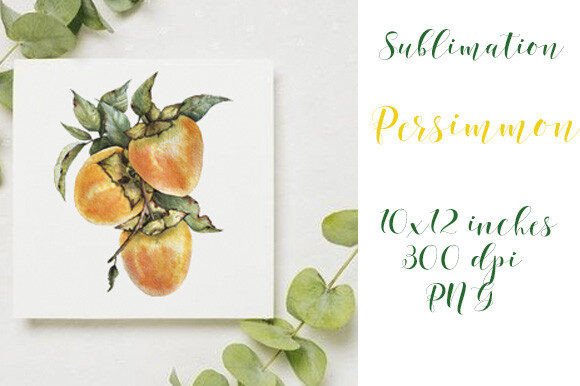
Sublimation of Persimmon Fruit PNG
A Watercolor Branch That Feels Like Autumn in Your Hands
The first time I opened the Sublimation of Persimmon Fruit PNG, I didn’t just see a fruit illustration—I felt its season. A single, vibrant persimmon hangs mid-branch, surrounded by soft, irregular watercolor leaves and subtle stem detail. It’s not hyper-realistic, nor is it cartoonish. It lands somewhere warm and intentional: like a hand-painted note tucked into a holiday gift box. As an embroidery designer who’s stitched hundreds of botanical motifs for Etsy sellers and boutique clients, I immediately pictured this on a linen tea towel, a cream cotton apron, or a lightweight sweatshirt for fall markets.
Where This Design Earns Its Keep—Real Projects, Real Reactions
I tested Sublimation of Persimmon Fruit PNG as the centerpiece for a custom embroidered tote bag—linen blend, medium-weight, with natural fiber texture. After digitizing it (yes, it’s a PNG, not an embroidery file—you’ll need to convert it), the shape held up beautifully: the fruit’s rounded form translated well into satin stitch, and the leaf edges softened naturally in fill stitch without looking muddy. Customers responded instantly. One buyer said, “It feels like something my grandmother would’ve framed—not just stitched.” That’s the quiet strength of this design: it carries warmth, not clutter.
It shines especially in contexts where handmade charm matters more than precision: baby onesies (paired with gentle running stitch outlines), holiday kitchen towels (where watercolor softness reads as cozy, not vague), and wedding favor tags (printed *and* embroidered—yes, many designers layer this PNG behind a simple monogram). For small shop owners, it’s a versatile anchor motif—use it solo on a pillow cover, repeat it subtly along a napkin hem, or scale it down for an embroidered patch on a denim jacket.
Where to Pause—and Why
This isn’t a one-size-fits-all embroidery asset. Because it’s built from watercolor brushwork—not vector lines—the fine tapering tips of leaves and delicate stem connections can vanish on tightly woven fabrics or under dense stitch density. On dark fabric, especially charcoal or navy, the subtlety of the washes gets lost unless you boost contrast in your digitizing software or add a light underlay. And on stretchy knits? Proceed with extra stabilizer and a test hoop. I’d avoid using it full-size on curved surfaces like caps unless you simplify the outer leaf edges first.
Small hoop sizes (under 4”) will require thoughtful cropping—zoom in before digitizing. The original 10 x 12 inch PNG gives breathing room, but that doesn’t mean every inch translates cleanly to stitch. Tiny interior highlights (like the faint blush on the fruit’s shoulder) won’t survive at 2 inches tall. If you’re planning a baby embroidery project, consider reinforcing those leaf veins with a light outline stitch—otherwise they may read as smudges, not intention.
What It Adds to Your Finished Product—Beyond Pretty
Sublimation of Persimmon Fruit PNG quietly elevates perceived value. It doesn’t scream “trendy”—it whispers “thoughtful.” That distinction matters for craft businesses. When customers see this on a personalized gift, they don’t just register “fruit.” They register care: in the color harmony, the organic spacing, the way the branch bends like something grown, not placed. That builds trust—especially for Etsy sellers listing handmade products where authenticity is currency.
For commercial embroidery, it works best when paired with clean typography or minimal supporting elements. Try it beside a short handwritten phrase (“Harvest Well,” “Sweet Season”) on a sweatshirt front—it balances weight and airiness. And for printable mockups? It renders beautifully across light and dark backgrounds, making digital product previews feel cohesive and professional without heavy editing.
Practical Notes Every Embroidery Designer Should Check
- Always test on scrap fabric first—especially with textured weaves or blends, since watercolor edges behave differently on linen vs. cotton poplin.
- Review thread color contrast before stitching: soft peach thread on ivory fabric may disappear; try burnt sienna or olive green for definition.
- Inspect small details at actual stitch size—zoom in on your embroidery software to confirm leaf tips won’t feather into nothing.
- Confirm licensing terms before selling finished items or bundling as part of a digital embroidery file pack—this is a Graphics asset, not pre-digitized machine embroidery design.
- Use proper cutaway or tear-away stabilizer depending on fabric weight—watercolor motifs show every puckering flaw.
- Try black-and-white mockups to gauge silhouette strength—if the shape reads clearly without color, you’re golden for holiday embroidery or monochrome branding.
- Compare performance on light vs. dark fabric backgrounds in your design software—adjust opacity or add subtle drop shadows if needed for versatility.
Final Thought: A Design That Grows With You
Sublimation of Persimmon Fruit PNG isn’t flashy—but then, the best design assets rarely are. It’s the kind of Illustrations piece that starts as a holiday card motif and ends up anchoring a small shop’s entire autumn collection: on mugs, patches, baby blankets, and embroidered tea towels alike. It rewards attention, not speed. Use it thoughtfully, test it honestly, and let its quiet seasonal warmth do the talking. For embroidery designers building a library of reliable, emotionally resonant Graphics, this one earns shelf space—not just download space.